
Design Research & Product Strategy

Rethinking In-Flight Entertainment

A user-centric research project for Thales, the global aerospace and defense leader behind many airlines' seat-back screens, reimagining how passengers discover and enjoy in-flight entertainment.
Role User Research · Strategy
Team 4-person team · USC
Type Design Research · 2024
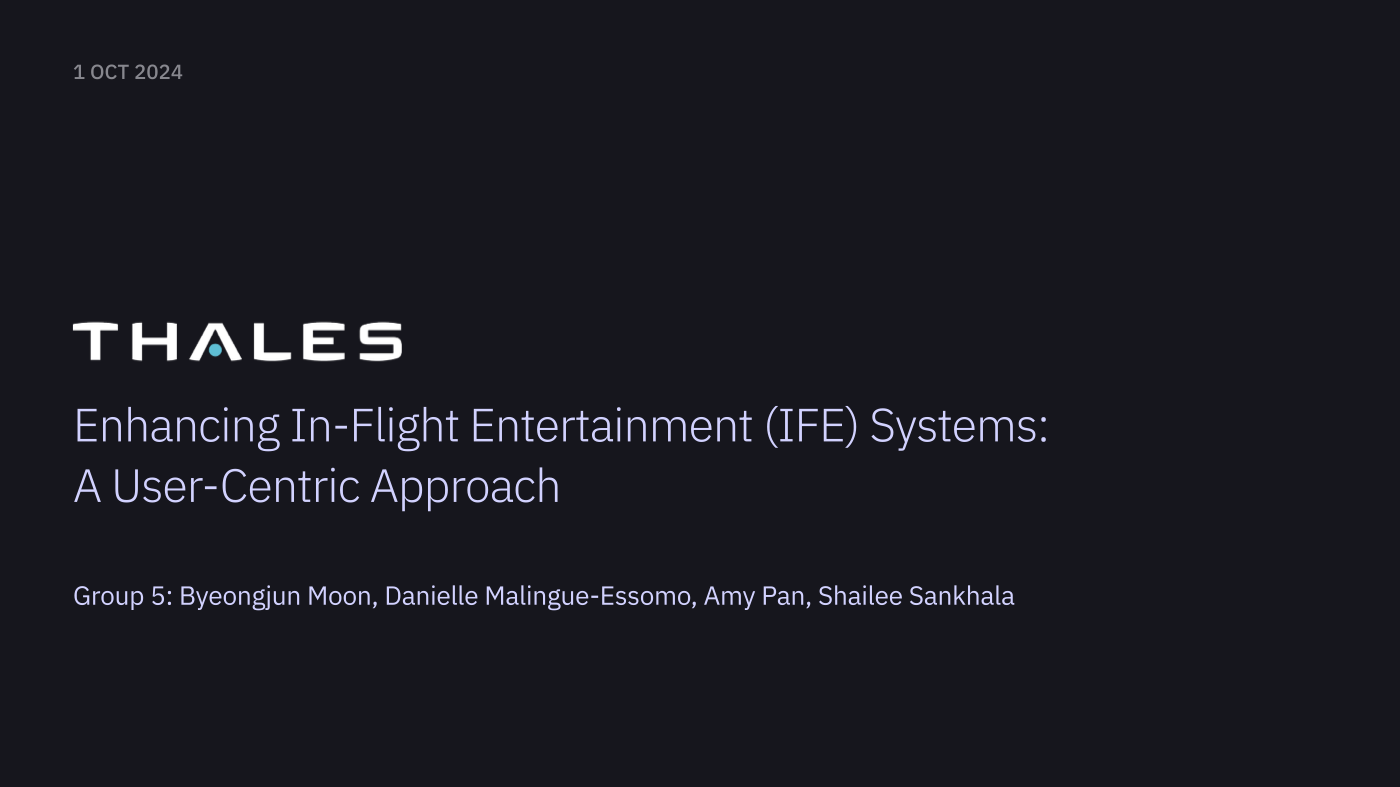
Title slide of the Thales IFE research deck
From the research synthesis deck presented to Thales · view the full deck ↗

A one-size-fits-all experience at 35,000 feet

Thales supplies the in-flight entertainment (IFE) systems behind many airlines' seat-back screens. The brief was open-ended: take a user-centric lens to the IFE experience and find where it could be better. We focused on content personalization and organization, the differing needs of passenger demographics, and the real opportunities to deepen engagement on a flight.

Two phases of research

Secondary Research

Literature Review Industry & Market Reports Comparative Analysis SWOT Analysis Review Content Analysis

We mapped the evolution of IFE and the emerging trends (hyper-personalization, bring-your-own-device, accessibility, seat-integrated tech) to understand where the industry was heading and where the gaps were.

Primary Research

User Interviews Psychographic Profiles Empathy Mapping Persona Creation Thematic Analysis Correlation Analysis

We interviewed passengers across different travel profiles, then used thematic and correlation analysis to turn their stories into empathy maps and personas that revealed distinct, often conflicting needs.

Three passengers, three very different flights

👨‍👧‍👦

Jason, 40s

Flies with his family and uses IFE to keep his kids entertained on long flights. Wants better family-friendly options and games they can play together.

💼

Kathy, 29

A business traveler who browses for two or three minutes, then switches to her laptop. Wants productivity tools, news, and live updates over generic entertainment.

🧓

Joseph, 60s

Enjoys films and documentaries but finds the text too small and the navigation confusing, spending up to 15 minutes just trying to find something.

What the research told us

🎯

Personalization is missing

A one-size-fits-all content wall leaves every passenger digging for something relevant, and most give up.

📱

Personal devices are winning

Passengers increasingly default to their own phones and laptops, so IFE has to earn attention back.

Accessibility is a real gap

Small text and confusing controls make the system genuinely hard to use, especially for older travelers.

🧭

Discovery is the pain point

Across every demographic, finding the right content fast was the single most common frustration.

A user-centric direction for IFE

We translated the research into a set of strategic recommendations and a roadmap of themes for Thales to explore, prioritized around the needs that surfaced most strongly.

AI-driven personalization

Recommend content by mood, flight duration, and passenger type instead of a static, generic catalog.

🧩

Accessible, simpler UI

Redesign navigation and readability so every demographic can find content in seconds, not minutes.

🎮

Social & interactive features

Add games and shared activities to lift engagement, especially for families and younger flyers.

🔗

Seamless device integration

Meet passengers where they already are by connecting their own devices to the IFE experience.

From an open brief to a clear direction

We took a broad, ambiguous enterprise prompt and turned it into an evidence-based product direction, complete with personas, prioritized findings, and a phased roadmap we presented back to Thales. It is the research and strategy foundation that good product decisions are built on, and the kind of thinking I bring before a single screen gets designed.